
Claude Code Is MS-DOS. Who Builds Windows?
The right way to think about Claude Code, and what'd the next evolution of Claude Code will look like.

MS-DOS was powerful, but most people needed Windows to actually use a computer. Claude Code is in the same spot: transformative for developers, but too “low level” for everyone else. This is causing AI adoption to be K-shaped, just like many things these days.
However, Claude Code can’t scale to the masses “as is”. A Windows moment is needed for Claude Code to truly bring agents to every knowledge worker. In this post, I’ll explain what the Windows era of Claude Code may look like, and the real barriers to getting there that people are glossing over. If that happens, there may be a significant speed up of “timelines”.
Claude Code has been having a moment. Anthropic doubled usage quotas over the holidays (perhaps in an attempt to keep its GPU utilization high), and Social Media has been full of engineers posting glowing testimonials.
For technical users who’ve spent a few days configuring it, Claude Code (V2) really does feel close to “AGI”. The model seems to understand your project, anticipate what you need, and execute with minimal hand-holding.
Meanwhile, enterprises are stuck. They are watching developers become productive with agentic coding, and asking the obvious question: why can’t every department do this? Chatting with ChatGPT or Gemini suddenly feels “boomer”.
The most surface level barrier is that the CLI (command line interface) is too minimalist for the average knowledge worker. But there are deeper, more fundamental issues with the form factor. (Note, everything in this post extends to Codex and Gemini CLI).
Claude Code requires one to have an intuition about file systems, the willingness to delegate, and the ability to think in systems, which the vast majority of people lack. What’s often labeled as “AI skill issue” is not even about knowing Claude Code’s features, per se. A lot of it is about letting go of old habits, and embracing that it’s ok to delegate to an AI. This explains why mass agentic AI adoption keeps stalling outside of a small radius inside developer community.
This leads to a K-shaped AI adoption trajectory. On one hand, you have DevRel influencers and the podcast intellectuals posting thought pieces about post AGI economics. If you are really in that “Claude Code Early Adopter” persona, AGI feels imminent. Heck, I feel it too. It sometimes feels imminent that software industry is subsumed by the AI complex, 50% of knowledge workers are laid off, and UBI is rolled out.
But real world is messy, incentives are often rigged against AI adoption, and Claude Code, as-is, won’t scale to the generalist knowledge worker. Someone will need to birth the “Windows” of AI—a layer that preserves the file system unlock while making it accessible to everyone. And no, it won’t be the current generation of chatbots that ushers it.
So in this post, I’ll explain what makes Claude Code special (hint: it’s not the model, nor the agent harness), which is the same reason why it won’t scale in its current form beyond the terminal savvy audience, and what the “Windows of AI” will need to look like.
Why Claude Code Actually Works (Intuition)
Here’s what most people get wrong about Claude Code: they think the magic is in the model or the agent harness (software that manages the model’s context and its interaction with environment). It’s not.
The magic is in imparting the agent harness the freedom to roam around inside your computer’s file system, and plan / spawn / execute tasks in parallel or sequentially as it sees fit, working in the background, and persisting across sessions.
In other words, the freedom to roam your file system is the unlock. Of course, models and harnesses need to have sufficient IQ to do it, but once that’s sufficient, it’s all about the computer access. Note, there’s also a big security angle here as well.
The importance of file system is best understood by contrasting our experience with chatbots (ChatGPT, Gemini, or Claude), which has conversation-based organization.
In a conversation-driven AI, you’re essentially in charge of manually massaging the context for a single conversation. You paste in code snippets, explain the project structure, upload relevant files. You upload reference images and ask chatbot to “use as a reference image”. But all that is for steering the chatbot within a single thread / conversation.
This creates a big problem: the docs and files you uploaded to a single conversation is scoped to that conversation only, and can’t be used automatically in a different conversation (because the new threads can’t “see” previously uploaded documents)
This severely cripples the chatbot’s ability to do ambitious, long running tasks - that involve many, many files. Note, ChatGPT, Gemini all have some “memory” to remember things about you and your preferences, but that memory isn’t designed to utilize documents from previous conversations.
Claude Code is fundamentally different. It has access to your entire project in your computer: your files, your SOPs, your history, your config. That increase in scope is where the real power comes from. The model isn’t reading your mind—it’s reading your file system.
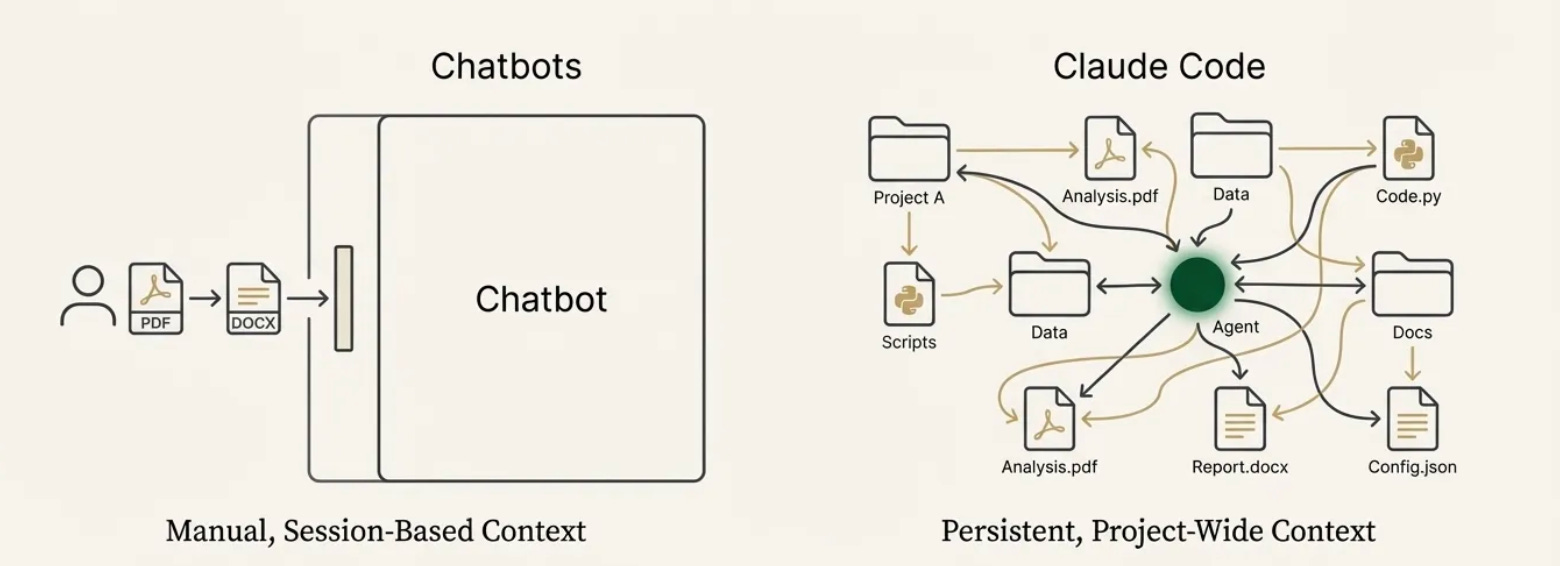
And here’s the key insight: with Claude Code, you don’t need a separate “memory” service to make things work. Memory is an emergent behavior from the file system itself. Your CLAUDE.md file, your project structure, your commit history—these become the memory. The agent reads them, learns from them, and builds on them. No special memory management required.
Thus, agent harness wrapping a file system is the unlock, not the model. The model is necessary but not sufficient. Put the same Sonnet model in a chat window and it’s helpful but limited. Put it in a harness with file system access and a freely roaming agent, and suddenly it feels like it understands your work.
Once you understand that Claude Code is essentially a model with project-wide context and autonomous agency over your files, the interface becomes intuitive. The learning curve isn’t about the AI, it’s about trusting the harness.
So if Claude Code is this powerful, why do we need another form factor (e.g. Windows of AI)? Because the same thing that makes it powerful—direct file system access via command line—is also what makes it inaccessible.
Barrier 1: Claude Code Is the New DOS
When Microsoft released DOS, it was a genuine leap forward. Before it, you needed access to an actual terminal. But DOS didn’t democratize computing to everyone—Windows did. The graphical interface is what brought computers to the masses.
Claude Code is in the same spot. It’s a genuine leap forward for developers. But the text-only interface is daunting for anyone who isn’t already comfortable in a terminal. Most knowledge workers will never open a CLI, let alone configure one.
And it’s not just the terminal. Claude Code has concepts like “skills” and “agents”—configurations that live in hidden folders on your file system. These are powerful primitives that let technical users customize Claude’s behavior.
But they’re low-level constructs. Average knowledge workers won’t learn them. And they shouldn’t have to.
To be clear: Claude Code is excellent for developers, AI enthusiasts, and intellectually curious people who can pick up new concepts. The question is whether that paradigm scales to everyone else—HR, Legal, Sales, Finance, etc. The answer is, no.
Now, Claude does have a web interface. And it’s intuitive. But here’s the problem: Claude Web doesn’t have access to your file system. It’s straitjacketed by the same chat aperture problem as ChatGPT—you have to manually specify context every session. So you’re forced to choose: power without accessibility (Claude Code), or accessibility without power (Claude Web).
That’s the fundamental issue with chat-based interfaces. They’re accessible, but they can’t tap into the file system unlock that makes Claude Code feel like magic. Until someone bridges that gap, we’re stuck in the DOS era.
But there’s an even bigger problem with Claude Code for mass adoption.
Barrier 2: How Claude Code Fundamentally Clashes With Enterprise Knowledge Management
In the rest of this analysis for executive/founder-tier subscribers, we talk about:
more real barriers enterprises face in adopting Claude Code,
my thoughts on what “Windows of AI” looks like
who’s positioned to build it
investing implications (?)
Executive tier subscribers also get access to my Predictions for 2026 in AI, archived exec-tier content, and company level deep dives in enterprise AI. Prices for executive tier will increase in end of this month by 20%.
Or, you can gift this subscription to your colleagues.