
Claude Code is the New Excel
The coming tsunami of general purpose intelligence

Claude Code is the new Excel.
Vibe coding is the new pivot table.
Model training is the new coding.
I’ve been thinking about how to explain Claude Code / CoWork better to people. The “Excel” analogy is the first one that actually sticks.
For forty years, Excel was the undisputed king of general-purpose knowledge work. It separated the savvy from the rest in every white-collar function on the planet. It became the lingua franca of finance and accounting, and then quietly colonized every domain. Entire businesses still run on spreadsheets attached to emails.
But that reign is ending, and people aren’t paying enough attention.
Agentic AI tools—Claude Code, CoWork, OpenAI Frontier—are on track to replace Excel as the baseline skill of knowledge work.
Not “someday”, but this year.
And just like people ran entire businesses on spreadsheets, future businesses will run on mostly on whichever wins the agentic OS war. Claude Code already runs my business in every functional domain.
In that world, vibe coding is what pivot tables were: a higher-order fluency that lets you get more leverage inside the same tool everyone has. What was “coding” before becomes model training and finetuning, especially since the “model” IS the “product”.
But the market is still mis-pricing the coming ubiquity and impact of Claude Code (or OpenAI Frontier, used interchangeably here). Anthropic dropped an interesting stat yesterday: Claude Code is already at roughly a $2.5B run rate, growing 100%+ in January alone.
That implies a product that will transcend any particular domain boundary, aka it won’t be contained to just coding. Also implied is a huge head room remaining. Excel is a ~$40B business. Office is roughly ~$120B. That gap alone suggests Claude Code can still grow 50x. It’s still very early.
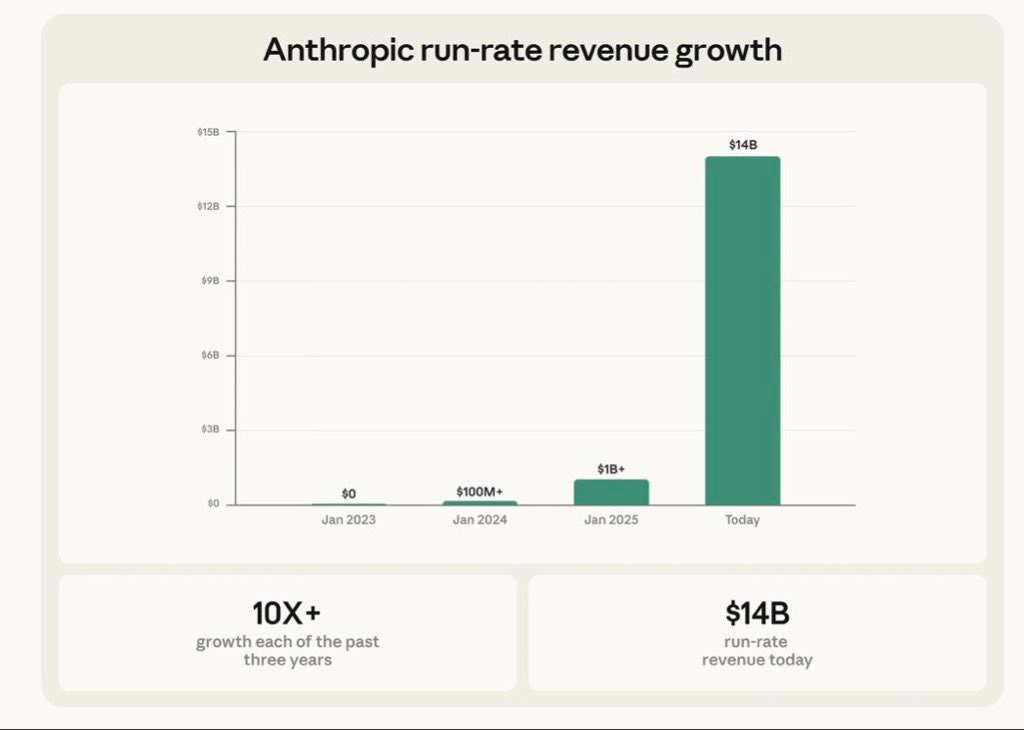
What matters isn’t the current number; it’s the slope.
Claude Code is compressing what took Excel decades into quarters through viral PLG. The DevRel playbooks on social media are the well-oiled machines of spreading Claude Code through productivity porn.
And when something becomes a standard, the ecosystem reorganizes around it. Excel didn’t just win because it was a spreadsheet. It won because it became the default interface for “doing work with data.” Once it owned that position, everyone plugged into the Excel ecosystem, not the other way around. Excel became an assumption.
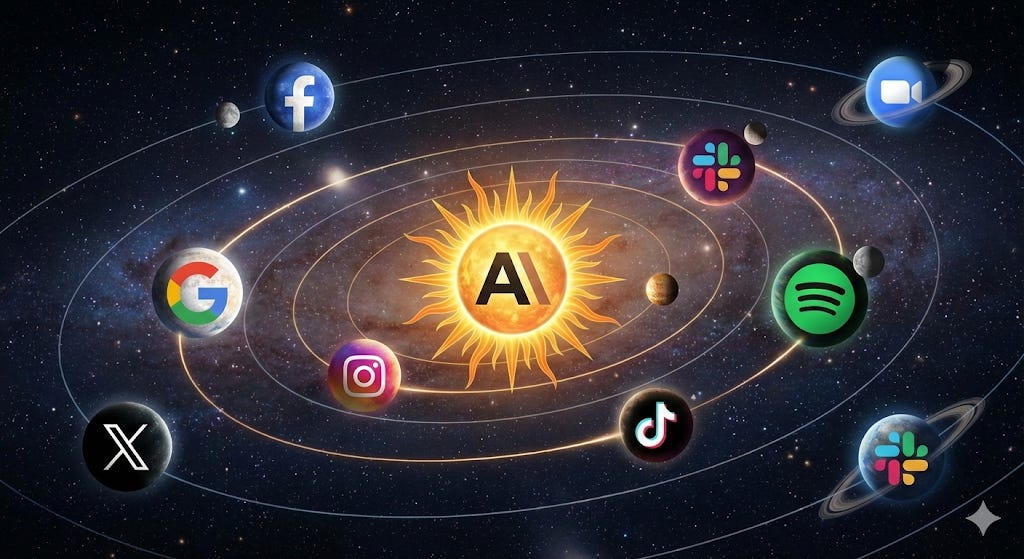
In other words, Excel is / was the substrate of work. Similarly, the industry will organize around the new “Suns” (Anthropic / OpenAI), with skills, plugins, and integrations orbiting the core tool. People are already frantically contributing Claude Skills into shared repos.
That has implications most enterprise AI builders are not ready for. For one, it becomes clear what are the “tarpit” ideas. Nobody built “Excel for accounting” or “Excel for inventory management” or “Excel for Financial Modeling”. People learned Excel and that was that. Excel captured almost all value in that space.
The software that survived wasn’t “more spreadsheet.” It was software that had real structural differentiation over Excel—especially around UX, coordination, workflow, and proprietary data.
But it will be harder to differentiate from Claude Code than it ever was to differentiate from Excel, because Claude Code is more general-purpose, more composable, more scalable, and improving every day, not at some release cycle cadence. UX is less meaningful when agent delivers outcomes. Thus, recent UX innovations are happening mostly for alleviating the pain of managing agent swarms, etc.
Speaking of vibe coding, many tax and finance professionals I personally know are vibe-coding lightweight apps already, with zero coding background. Some are even launching their own AI powered CPA services, etc. The constraint is domain knowledge now, not web development skills.
Now, before some of you cry “but, but it’s not production quality“ or “non-developers don’t know what they are doing, they will hire a developer to fix their vibe coded mess”.. here’s what many don’t get:
Businesses run on a ton of “brittle spreadsheets” already. People have been “vibe spreadsheeting” for a long time. Vibe coded apps are an extension of that, except Claude Code is already super-human in its ability to whip out simple dashboards and CRUD apps.
Most enterprises have 1-2 gung-ho people (often young people eyeing promotions) who will go to great lengths to build automations. When I started as a trading analyst back in 2007 (great timing, just before the financial crisis), I spent almost a year building and operating spreadsheets to help senior traders. That grunt work was what got me promoted to associate. Similarly, people that use AI effectively at work will be the new rockstars.
So when is this shift going to happen, you ask. It’s already happening.
Claude is eating Excel jobs, and finance industry is the canary in the coalmine. Wall Street is adopting Claude both top down and bottom up. Goldman Sachs reportedly embedded Anthropic engineers for six months to automate large back-office functions—accounting, compliance, KYC—at real scale (confirmed via their earnings call). Even slow-moving banks are reorganizing around Claude as the operating system. By 2027, every verifiable task will follow finance and accounting trajectory.
But the analogy between Excel and Claude Code ends there.
Claude Code is far more disruptive than Excel, and creates a K-shaped divide along the fault line of AI literacy.
Agents give you outcomes, not just automation. Excel automated calculations. Agents complete entire tasks end-to-end—draft the memo, review the contract, file the report.
Agents scale through self-multiplication. Spin up N agents doing N tasks in parallel. You’re not one person working faster. You’re one person with a team.
Agents self-improve without you doing anything. Every time Anthropic or OpenAI ships a new model, your agents get better overnight. Your spreadsheet never got smarter on its own.
Will everyone learn how to use AI? No, just like the majority of the population never figured out Excel. But the impact of not using AI will be devastating for many, and accelerate K-shaped economy. Not knowing Excel meant you were less competitive—slower, more manual, but survivable. Not using AI agents means you’re almost bionically outmatched, since you are competing with cybernetically augmented people.
Implications for Enterprise AI
Right now, there’s a massive whitespace to fill in enterprise AI. Much of it will be filled by Claude Code or OpenAI Frontier—if these are truly the “Excels” of this era.
The real kicker versus Excel: these platforms are self-improving. They keep absorbing use cases like a black hole. Six more months of 100% MoM growth and enterprise AI startups are selling into a fundamentally different landscape.
The faster Claude Code grows, the further the TAMs will shrink for startups.
Nobody launched “Excel for Accountants.” Accountants just learned Excel.
The software that survived solved problems Excel structurally could not easily—Salesforce for CRM, SAP for ERP, Bloomberg for real-time market data. Regulatory moats, proprietary data feeds, genuine domain complexity—those still matter. But the pluggable architectures of skills and plugins keep narrowing the gap, and computer use agents will close whatever’s left.
Just like no one wants to use Lotus 123 or Apple’s Numbers for spreadsheets, same will happen to enterprise AI platforms. It’s hard to imagine scenarios where an enterprise adopts a multitude of agentic platforms, especially when the trend is to consolidate subscriptions and IT spend.
This means startups will have to think harder about differentiation and execute faster than Anthropic’s or OpenAI’s teams, lest they get priced at service company multiples. Deep vertical data, regulatory moats, genuine domain complexity (drug discovery, surgical robotics), durable network effects—those are real moats. Everything else is a feature Claude Code ships in a quarter.
But the real question is this: is there really any moats left when most value is in the capital?
Join 60K readers per month to stay ahead of the curve on AI trends.
Premium subscribers will get access to exclusive content. Fun fact, many execs at the big labs are subbed. See testimonials.
About Me
I write the “Enterprise AI Trends” newsletter (read by over 60K readers worldwide per month). Previously, I was a Generative AI architect at AWS, an early PM at Alexa, and the Head of Volatility Index Trading at Morgan Stanley. I studied CS and Math at Stanford (BS, MS).
Enterprise AI Trends. All bangers all the time.
Your capital comment at the end feels like a step in a different direction from the rest of the article. Especially when you equate it in comments to the $200 / mo subscription ...
I don't expect those prices to last ... And at some point the govt will step in to stop consolidation though as always too late.
What I don't see anybody analyze is what will all these companies do with they increased internal efficiencies and increased output when masses of people will be jobless and cannot afford said products.
This apocalyptic view on AI's effect on all jobs leads to exactly that. Who will buy the products?
I mean you can see now Waymo paying DoorDashers to close their doors which is dystopian already ... But what will happen when people will not be able to pay for driverless taxis?
And to be clear I am not trying to be contrarian ... I am genuinely curious to hear from the brilliant minds I follow what they see is the solution at the other end ...