
OpenAI's Ad Business Is Misunderstood
The market is incorrectly pricing OpenAI's ad business for sentimental reasons

Join 50K monthly readers to follow the strategic shifts in AI. In case you missed, our last two posts:
Yesterday, OpenAI announced that they’re testing ads in ChatGPT’s Free and Go (the $8/mo tier) versions. Understandably, Twitter immediately lit up with negative reactions: “Sam’s desperation move,” “they got cooked by Claude,” “adding ads after slipping on enterprise”, etc.
Thus, the sentiment on OpenAI is squarely in the “negative” territory. And for good reasons. Claude Code is eating their lunch in developer and enterprise mindshare. ChatGPT growth stalled in Q4 2025 on a sequential basis. Its ventures into wearables and robotics make them seem scatterbrained and unfocused. Just like that, the narrative on OpenAI has shifted from “inevitable winner” to “desperate incumbent.”
So when the ads announcement dropped, it landed as a confirmation of the bear case.
But here’s what the dunking misses. First off, OpenAI always said they were going to be ad supported partially. I even wrote about why back in June 2024, that ad business is necessary for OpenAI as a hedge against LLM commoditization.
More importantly, OpenAI might have just announced the most important shift in direct response advertising in 20 years, since AdWords. They literally just invented a new ad format in a greenfield channel. And because everyone’s so bearish on them right now, nobody’s correctly pricing in what happens if it actually works.
When you focus just on facts and numbers, it’s unlikely that ads become OpenAI’s demise, but rather help it gain marketshare away from Google and Meta.
What Actually Happened
But first, quick level set on the launch.
OpenAI said it will test ads in “coming weeks” for free and Go tier (the $8/mo tier) users in the U.S. only. The format: sponsored products and services at the bottom of answers, clearly labeled, separate from the organic response. Pro, Business, and Enterprise tiers remain ad-free.
The principles they laid out:
ads never influence answers,
conversations stay private from advertisers,
users can turn off personalization,
they won’t show ads to under-18 users or near sensitive topics like health and politics.
The example they showed is revealing: a query about “best Mexican dinner recipes” returning a hot sauce product placement alongside the response (see below). That’s not accidental positioning. It ties well with OpenAI’s recent ambitions to grow its e-commerce partnerships revenue (w/ Walmart, Shopify, Target, etc).
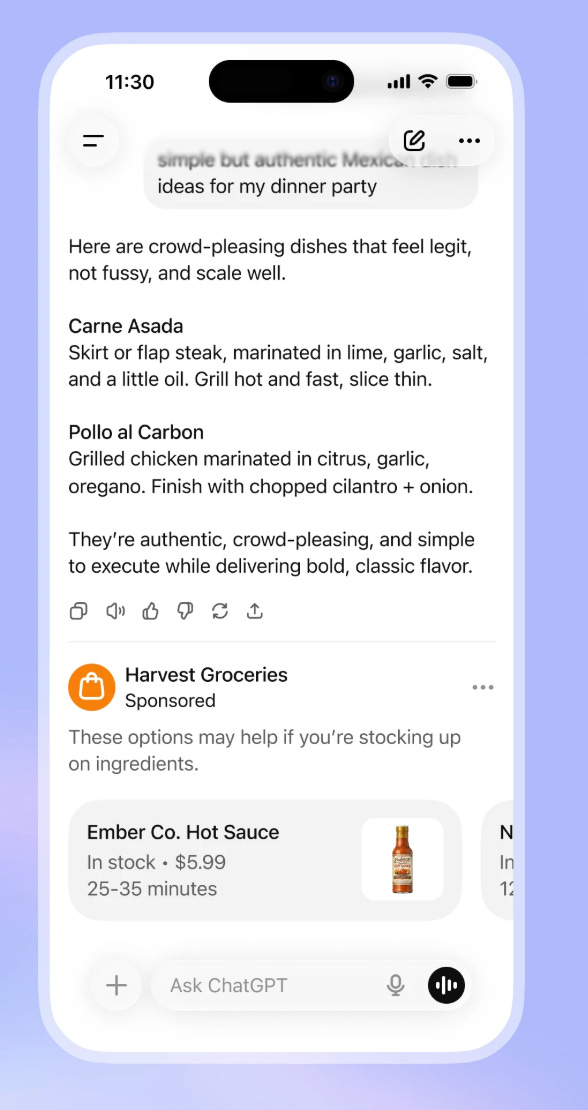
You can imagine how these ads are useful for driving e-commerce revenue, but that’s barely scratching the surface.
Paid tier readers will have access to my tactical market commentary focusing on the biggest shifts in AI (like this), as well as my paid post archive. Support this publication by joining paid tier. Join hundreds in our community.
For executive tier members, we also publish strategy deep dives from operator / investor lens. Prices will go up end of this month. See testimonials.